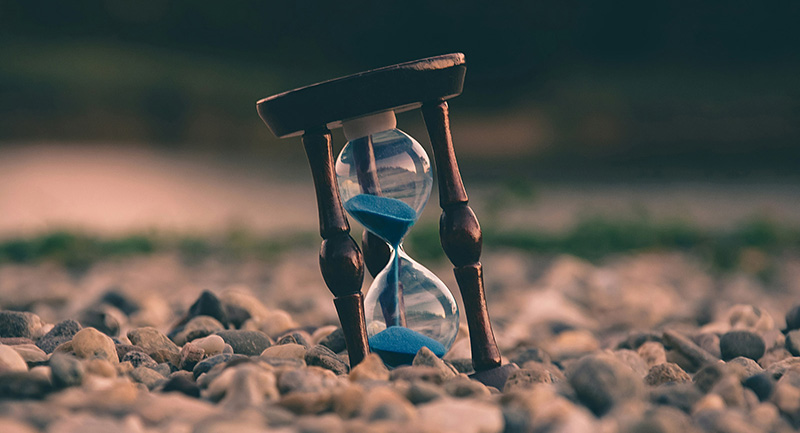
How Does Time Pass?
Does time really flow, or do we use the concept of “time” in our minds in order to describe the sequence of events and change?
For a moment, imagine that everything in the universe stopped. The planets are not turning, atoms are not moving, light is not advancing; nothing is changing, no event is taking place.
Could we say that time was passing in such a universe?
If your answer is no, you would be accepting that time is related to events. If there is no event, the difference between “before” and “after” also disappears. What makes it possible for us to notice it is change; one state ending and another beginning, events following one another, and the universe never remaining completely the same.
We need a scale of time in order to express the flow in the universe and in our lives. However, when our brain records events, time information remains in memory when it is part of the event itself. For example, if you did not look at the clock when you woke up in the morning, you cannot express that moment as “I woke up at 08:17.” Therefore, when remembering the past, most of the time we reconstruct not time directly, but the sequence and context of events.
Zacks and colleagues (2007), in their study titled Event Perception: A Mind/Brain Perspective, proposed Event Segmentation Theory, which explains how people perceive activities that flow continuously in everyday life as separate events and how the boundaries between these events regulate attention and memory.
Accordingly, instead of recording continuous experience exactly as it is, our brain divides it into meaningful events; this process is called event segmentation. At the same time, it creates an event model corresponding to the question “what is happening right now?” and uses this model to make sense of ongoing experience. In this process, the brain generates predictions about what will happen a little later. The current event model is maintained as long as it predicts what is happening well enough. However, when the difference between what is expected and what actually happens, that is, the prediction error, increases noticeably, this change is perceived as an event boundary, that is, an event boundary, and the current event model is updated according to the new situation.
Let us explain this with an example.
Imagine that you are preparing dinner in the kitchen. Your mind organizes this process not only as a single “preparing dinner” event, but as a structure divided within itself into smaller and meaningful parts.
First, you take the ingredients out onto the counter, chop the vegetables, prepare the spices, put the pan on the stove, add the ingredients to the pan in a certain order, and begin cooking. In this way, the experience is divided into smaller event units that take place within a broader event.
Meanwhile, your current event model generates predictions about how the event will continue a little later. For example, you can predict that you will soon add cumin, that the consistency of the sauce will change, and that you will then stir the food again.
Just at this moment, imagine that your phone rings. You leave the food and go out onto the balcony to talk. When your friend begins talking about some matters concerning your close surroundings, you also begin remembering different events, people, and places depending on the flow of the conversation.
Your mind is now following not the ingredients in the kitchen and the next steps of the meal, but the people and events that are the subject of the conversation. What is happening now has diverged from the flow predicted by the current event model. This mismatch between the predictions and what actually happens increases the prediction error.
This change is perceived as an event boundary and the event model is updated according to the new situation; what the system now represents as “what is happening right now” is not preparing food, but having a phone conversation.
With this change, you do not only move on to a new event; when an event boundary is formed, the active representation in working memory is also updated. In other words, the information “I am cooking, the pot is on the stove,” which was at the center of the mind a few seconds ago, is not completely erased, but it is no longer the priority.
Zacks and colleagues also stated that event boundaries update the contents of working memory and that information from immediately before the boundary can become more difficult to access afterward. In the study conducted by Dodhia and Dismukes (2009), when a task is interrupted, an intention in the form of “I should return to this task later” must be encoded in the mind. Remembering this intention later falls within the scope of prospective memory.
So, becoming absorbed in talking on the phone and suddenly remembering after a while, “The food was on the stove!”, can be explained not by the previous event being completely forgotten, but by the information belonging to it being temporarily pushed into the background during the new event. However, if an appropriate cue does not trigger this intention again, the person may forget to return to the unfinished task.
However, event boundaries do not only push previous information into the background; at the same time, they become reference points that organize memory.
Research shows that people who are better able to divide an activity into meaningful events remember what happened better later on. So, when you later remember that experience:
“I was cooking → the phone rang → I went out onto the balcony → I started talking”
you may remember it within a more orderly sequence of events.
These memories can be reactivated by a small cue. For example, imagine that while adding water to rice, you remember that another rice dish you made before became mushy. You did not consciously search for that old event, but reliving a small part of a past event triggered the rest of it.
Horner and colleagues explain this mechanism as pattern completion: When an individual encounters a detail belonging to a past event, the rest of the event can also become reactivated. The researchers’ fMRI findings show that different elements belonging to an event, such as place, person, and object, are represented in different regions of the brain and that the hippocampus can create a coherent event representation by linking these pieces together.
If you are making rice for the second time, adding water to the pot right now may increase the likelihood of remembering your single past rice-making experience. However, if you have made rice dozens of times over the years, “adding water” is now associated with many similar memories.
When there are more possible targets under the same cue, the effectiveness of that cue in retrieving a particular memory decreases. Watkins & Watkins call this cue overload: the more memories the same cue is associated with, the more its power to retrieve a particular memory decreases.
In addition, how much the context between the period in which the memory was formed and the present moment has changed is also important. According to Howard and Kahana’s Temporal Context Model, as new information and events enter in between, the context changes; this can also make access to the old memory more difficult.
However, which memory comes to the forefront is not determined only by the number of similar memories and contextual proximity. Some experiences may be placed in memory more strongly than others because of the emotional importance they carry.
According to Richter-Levin and Akirav’s Emotional Tagging hypothesis, an emotionally arousing experience can be marked as “important” by the amygdala, and this contributes to the memory being consolidated more strongly in long-term memory.
Up to this point, we have talked about which memories come to the forefront; however, how similar memories are recorded in memory is also important.
When events experienced at different times share common features, these experiences are also linked to one another in memory. Shohamy and Wagner call this process integrative encoding. Accordingly, the hippocampus can also integrate these separate events experienced at different times into a connected memory network through their common features.
So, how do we perceive an event we experience temporally?
Even when the same physical duration is involved, an activity that we have newly learned and that requires us to pay more attention to its details can be perceived as having lasted longer than an activity that we have repeated many times and that has become largely automatic (Tse et al., 2004; Matthews, 2011; Haith & Krakauer, 2018).
Novelty is not the only reason an activity feels as though it lasts a long time; sometimes, on the contrary, not offering something sufficiently new or valuable also changes the perception of time.
When we cannot obtain enough information, progress, novelty, meaning, or reward in return for the cognitive effort we expend, the value of the current activity may decrease (Shenhav et al., 2013) and boredom may emerge. Boredom works like a signal that encourages us to turn toward more valuable alternatives (Kurzban et al., 2013).
However, if we cannot leave the situation we are in, our attention may gradually shift from the activity itself to the passage of time; thus, we begin thinking about how slowly time is passing. The studies reported by Wolff and colleagues (2025) also show that during boredom, attention is directed toward the passage of time and that time can be felt as though it is passing more slowly.
So, “how does time pass?”
The answer is not the same in every situation. Sometimes the minutes seem never to pass, while at other times we do not notice how the hours have passed. When we look back, we evaluate the time that has passed through the events we experienced and the traces they left in our memory.
As a result, even though time is measured with the same units, we do not always experience it in the same way.
References
Dodhia, R. M., & Dismukes, R. K. (2009). Interruptions create prospective memory tasks. Applied Cognitive Psychology, 23(1), 73–89. https://doi.org/10.1002/acp.1441
Horner, A. J., Bisby, J. A., Bush, D., Lin, W.-J., & Burgess, N. (2015). Evidence for holistic episodic recollection via hippocampal pattern completion. Nature Communications, 6, 7462. https://doi.org/10.1038/ncomms8462
Howard, M. W., & Kahana, M. J. (2002). A distributed representation of temporal context. Journal of Mathematical Psychology, 46(3), 269–299. https://doi.org/10.1006/jmps.2001.1388
Kurzban, R., Duckworth, A., Kable, J. W., & Myers, J. (2013). An opportunity cost model of subjective effort and task performance. Behavioral and Brain Sciences, 36(6), 661–726. https://doi.org/10.1017/S0140525X12003196
Richter-Levin, G., & Akirav, I. (2003). Emotional tagging of memory formation—In the search for neural mechanisms. Brain Research Reviews, 43(3), 247–256. https://doi.org/10.1016/j.brainresrev.2003.08.005
Shenhav, A., Botvinick, M. M., & Cohen, J. D. (2013). The expected value of control: An integrative theory of anterior cingulate cortex function. Neuron, 79(2), 217–240. https://doi.org/10.1016/j.neuron.2013.07.007
Shohamy, D., & Wagner, A. D. (2008). Integrating memories in the human brain: Hippocampal–midbrain encoding of overlapping events. Neuron, 60(2), 378–389. https://doi.org/10.1016/j.neuron.2008.09.023
Watkins, O. C., & Watkins, M. J. (1975). Buildup of proactive inhibition as a cue-overload effect. Journal of Experimental Psychology: Human Learning and Memory, 1(4), 442–452. https://doi.org/10.1037/0278-7393.1.4.442
Wolff, W., Ozay-Otgonbayar, S., Danckert, J., Bieleke, M., & Martarelli, C. S. (2025). Effort and boredom shape our experience of time. Neuroscience & Biobehavioral Reviews, 178, 106375. https://doi.org/10.1016/j.neubiorev.2025.106375
Zacks, J. M., Speer, N. K., Swallow, K. M., Braver, T. S., & Reynolds, J. R. (2007). Event perception: A mind/brain perspective. Psychological Bulletin, 133(2), 273–293. https://doi.org/10.1037/0033-2909.133.2.273